

External Agents
External agents are built outside watsonx Orchestrate and can be used as collaborators for native agents. watsonx Orchestrate supports multiple provider protocols, including external_chat, the Agent-to-Agent Protocol (A2A), and specialized communication protocols for integrating with watsonx AI Agent Builder agents, watsonx Assistants, and Salesforce Agent Force agents.external_chat and A2A agents can be built on any underlying agent platform such as BeeAI, Langgraph, and CrewAI, where the user hosts the agent themselves, on Code Engine.
Providers
External Chat (Chat Completions API)
Theexternal_chat provider can be used to integrate with any agent that is capable of providing an OpenAI style chat completions endpoint and is the most common form of integration.
The documentation for this API spec can be found on the watsonx-orchestrate-developer-toolkit.
A reference Langgraph external agent can be found here.
Agent to Agent (A2A) Protocol
The Agent to Agent Protocol (A2A) is an open standard designed to enable communication and interoperability between multiple agentic systems. Because the standard evolves rapidly, watsonx Orchestrate specifies the A2A version in the provider field to ensure compatibility when communicating with agents. The currently supported version is 0.3.0. Earlier versions, such as 0.2.1, are deprecated and will be removed in a future release. To ensure continued support, use version 0.3.0 or later when registering A2A-compatible agents. For a sample LangGraph agent compatible with the A2A protocol, see the a2a-samples repository. To register an agent that is compatible with the A2A protocol, setprovider to external_chat/A2A/0.3.0, like the following example:
corr_id value received in the metadata of the initial request.
Push notifications use Bearer token authentication, where the token is generated from API keys as described in the Getting Started guide.
Callback URL and authentication
The callback URL is included in the request sent to the A2A agent. To send push notifications, you must:
- Use a valid API key to generate a Bearer token for authentication.
- Provide complete task update details in the notification payload, following the A2A protocol’s task object specification. Partial status updates are not sufficient.
watsonx AI Agent Builder
You can also integrate with agents built using watsonx.ai’s agent builder platform. For more information, see Registering agents from watsonx.ai. Instead of using the API, complete the following YAML file and import your agent. Provide well-crafted descriptions for your agents. These descriptions are used by supervisor agents to determine how to route user requests. For more information, see Writing descriptions for agents.Salesforce AgentForce
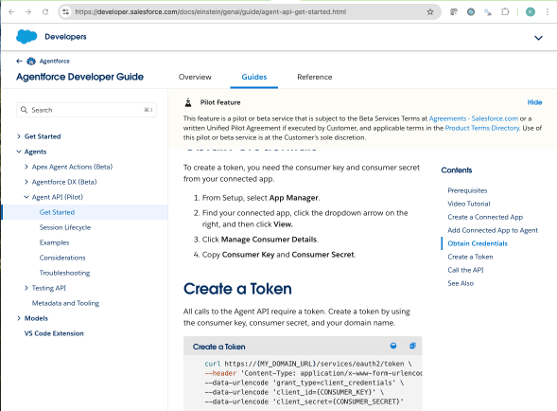
To register an agent that is built within Salesforce Agent Force as an external agent:- Follow the Getting Started Guide for the Agent API. For more information, see the Getting Started Guide.
-
On the Create a token page, the following information applies to all Salesforce agents within the instance:
api_url: Always set tohttps://api.salesforce.com/einstein/ai-agent/v1.auth_config.token: Use theCONSUMER_SECRETprovided in the guide.chat_params:client_id: Use theCONSUMER_KEY.domain_url: Use theDOMAIN_URL.- Optionally, specify a list of display types to pass to Orchestrate as a comma-separated string.
- Provide well-crafted descriptions for your agents. These descriptions are used by supervisor agents to determine how to route user requests. For more information, see Writing descriptions for agents.
-
Lastly, under
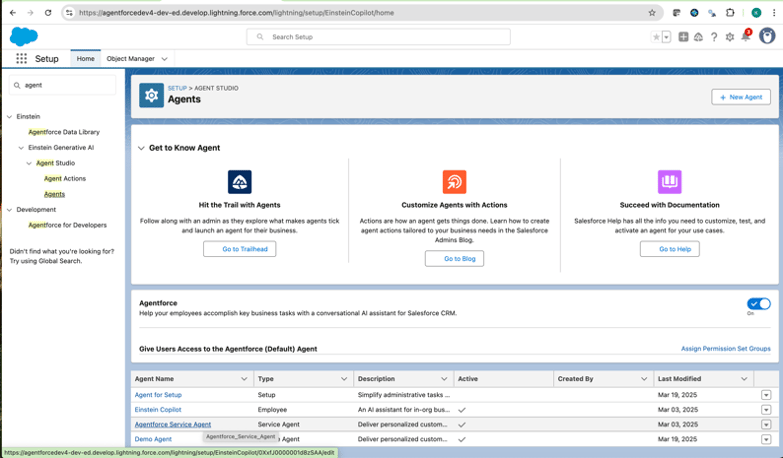
chat_paramsyou need to specify youragent_id. This can be found by hovering over one of your agents and either right-clicking and copying the URL, or by manually writing it based on hover text. In the following example, the agent_id is0XxfJ0000001d8zSAA.
External watsonx Assistants
To register assistants from watsonx Assistant, you must obtain the following information:service_instance_urlapi_keyassistant_idenvironment_id
Note: The location of the
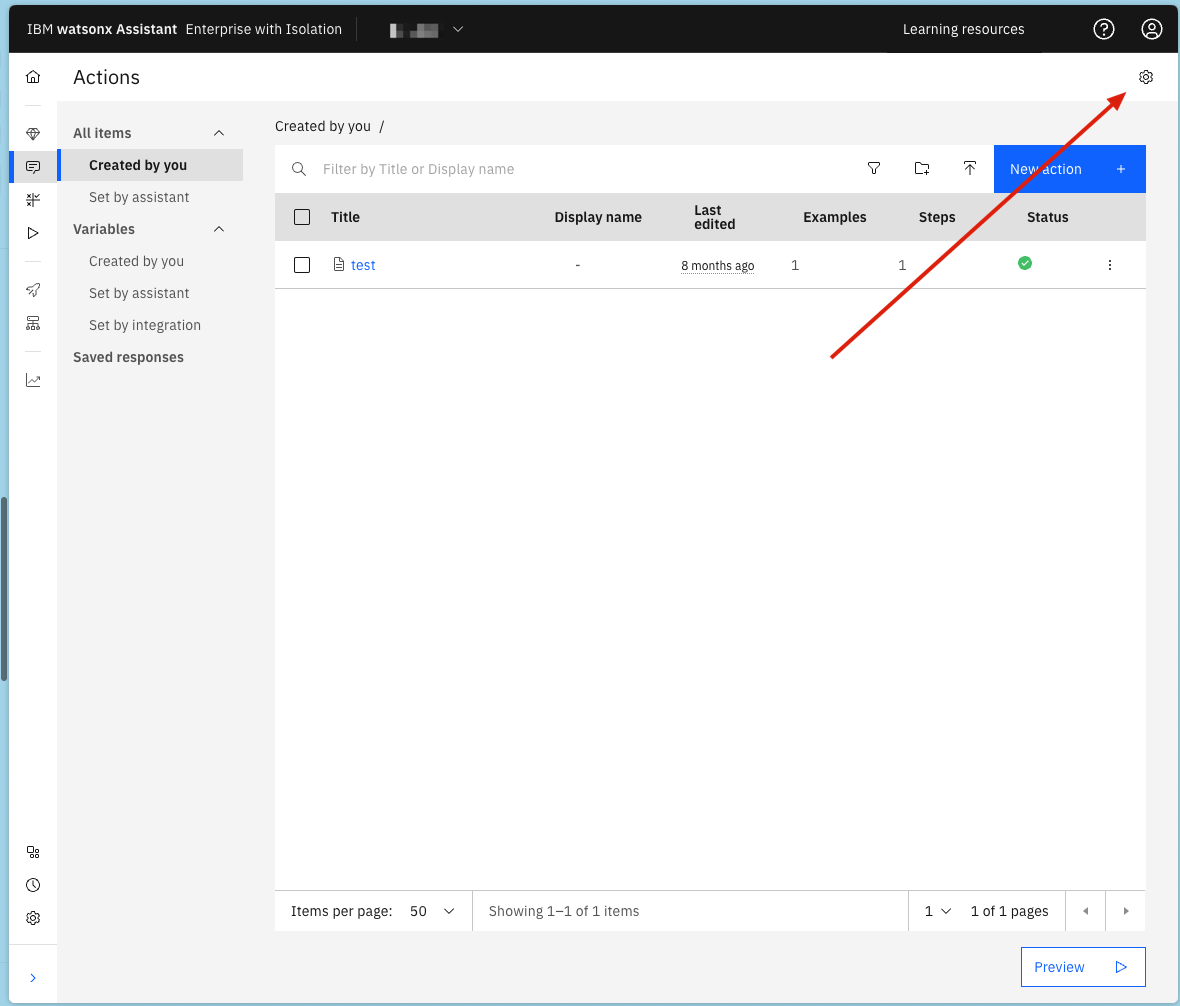
service_instance_url and api_key varies depending on whether the assistant is imported to IBM Cloud or AWS.- Navigate to the settings on the actions page and open the settings.
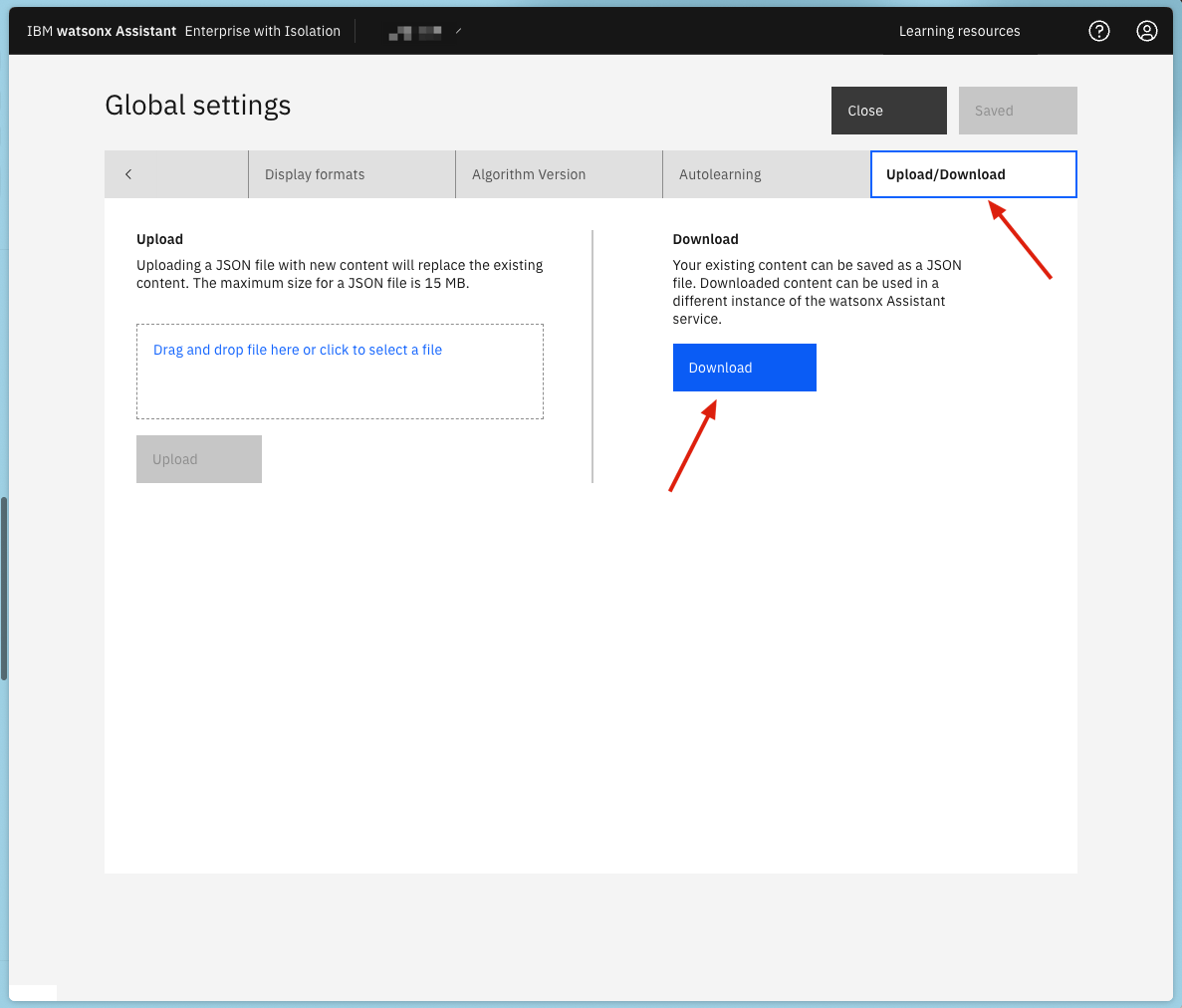
- On the farthest right tab, select Upload/Download, and click the Download button.
- Locate your
environment_idandassistant_idin the output JSON.
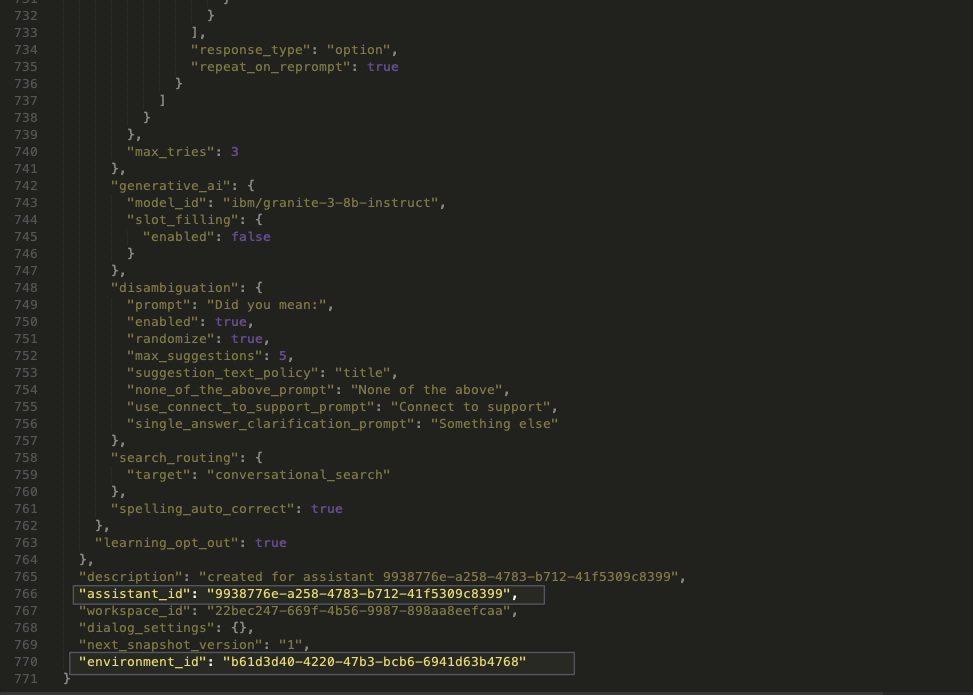
IBM Cloud
On IBM Cloud, yourservice_instance_url and api_key can be found on the page where you launch your assistant’s tooling UI.
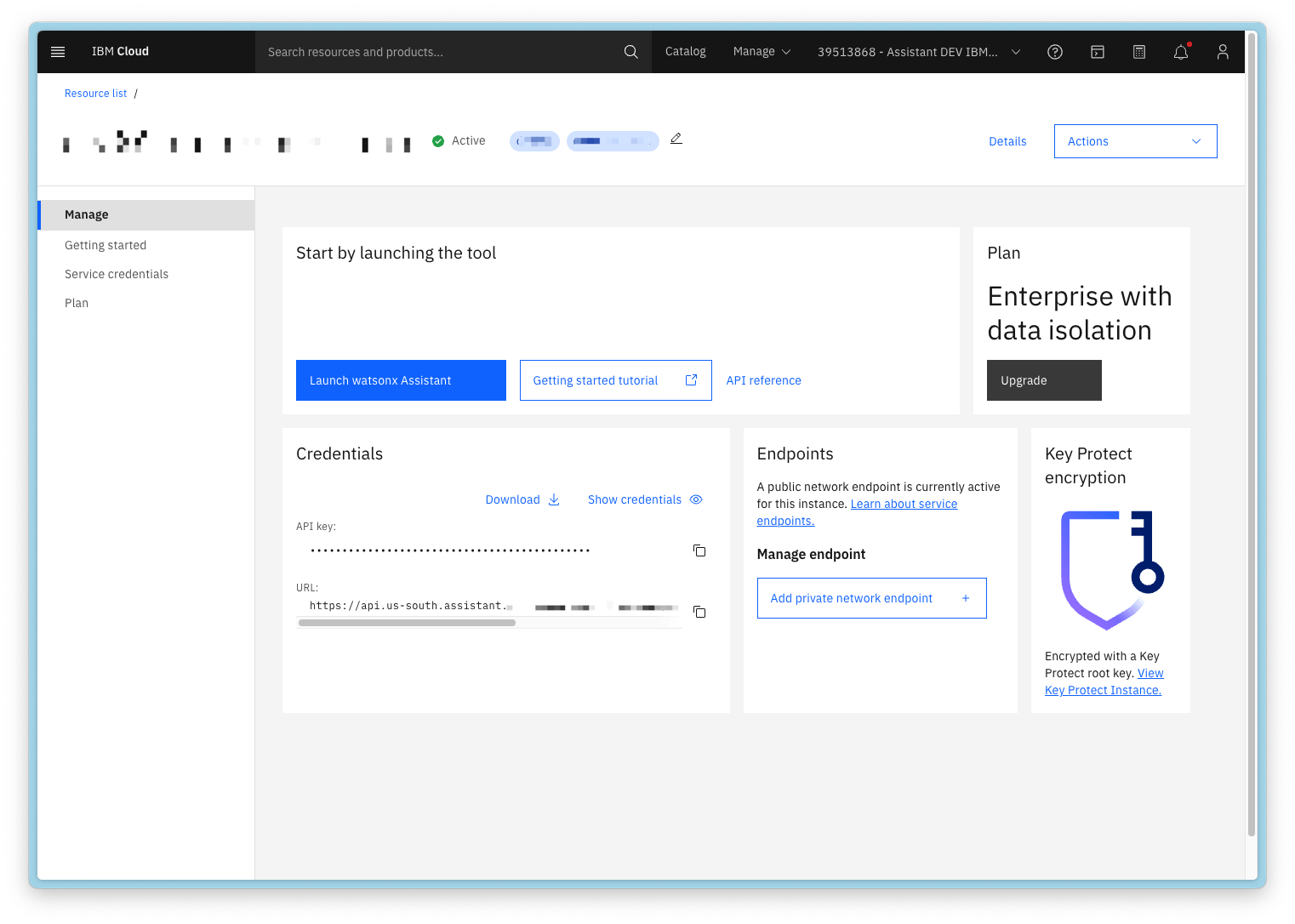
AWS
Provide well-crafted descriptions for your agents. These descriptions are used by supervisor agents to determine how to route user requests. For more information, see Writing descriptions for agents.Additional features of external agents
Providing access to context variables
Context variables enable builders to incorporate user-specific identifiers—such as username, user ID, or tenant ID—from upstream systems into an agent. These variables can currently be set through API-level integration by using the Runs API, the Chat Completions API, or its streaming variant. By default, agents invoked during a run do not have access to context. To enable access, set thecontext_access_enabled field to true and provide a list of context_variables to expose to the agent.
Context variables are passed to the agent in the following ways:
- Runs API: Use the context field at the root of the request.
- Chat Completions API: Use the context field at the root of the request.
- Streaming variant: Each SSE event sent to the agent includes the context object.
- The context variables defined will be accessible to external A2A agents in the metadata of the
messageobject.