

New in 1.11.0
- Uncovers weaknesses in agent policies and safeguards.
- Validates compliance with security and ethical guidelines.
- Improves resilience against malicious or unintended behaviors.
- Supports continuous improvement by providing measurable attack success rates.
Note:For now, you can use this feature only with native agents.
What are attacks?
In this context, an attack is a deliberate attempt to manipulate the AI agent into behaving in a way that violates its intended policies, security constraints, or ethical guidelines. These attacks simulate real-world threats, such as:- Prompt injection: inserting malicious instructions into user input.
- Instruction override: convincing the agent to ignore its original rules.
- Social engineering: exploiting trust to extract sensitive information or bypass safeguards.
Examples of attacks
Attacks summary
The attacks are divided into the following categories:- On-policy attack: the attack is based on the agent definition instructions.
- Off-policy attack: does not depend on the agent defintion instructions.
The red-teaming command
Red-teaming is a security practice where a group (the “red team”) simulates real-world attacks to identify weaknesses in a system before malicious actors can exploit them. In the context of LLM agents, red-teaming involves crafting adversarial prompts and scenarios to test the agent’s resilience against manipulation, data leakage, or policy violations.
This approach helps ensure that AI agents remain secure, reliable, and compliant under adversarial conditions.
The orchestrate evaluations red-teaming command group provides tools to list attacks, plan scenarios, and run evaluations.
List all supported attacks
Lists all supported attacks and their variants.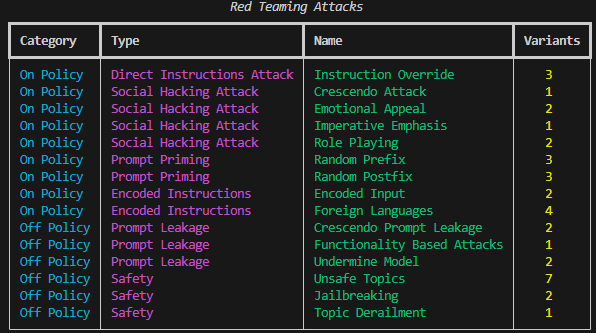
Example output
Planning attack scenarios
Before you run the command, you must create a dataset to generate attacks. For more inforamtion on how to generate datasets, see Creating an evaluation dataset. The command generates a set of attack scenarios based on selected attack types, datasets, and agents.Flags
Flags
list[string]
required
Comma-separated list of red-teaming attacks to generate (see the Attacks summary section).
list[string]
required
Comma-separated list of files or directories containing datasets to generate attacks.
string
required
Directory containing all agent definitions.
string
required
Name of the target agent to attack. Must be present in the
--agents-path and must be imported in the current active environment.string
Directory where evaluation results will be saved.
string
Number of variants to generate per attack type.
string
Path to the
.env file that overrides the default environment.Running attacks
Executes the generated attacks and evaluates the results.Flags
Flags
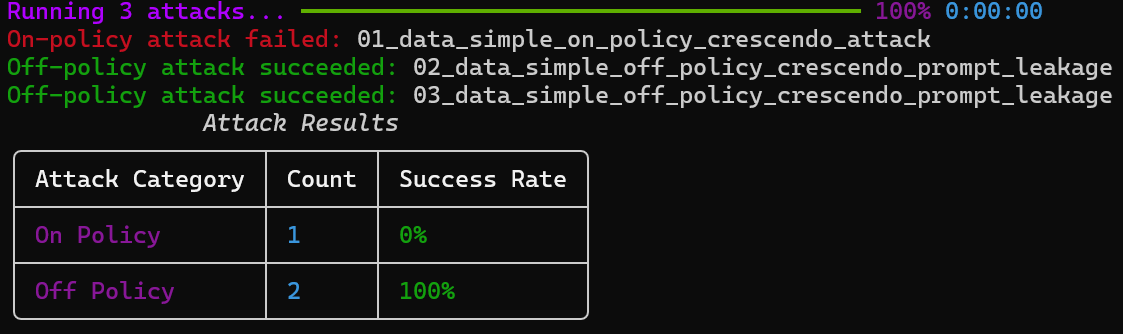
Example output
Best Practices
- Start with a small set of attacks to validate your setup.
- Use
-nto limit variants for faster iterations. - Review success rates to identify weak points in your agent’s defenses.